Carbon
Industrial carbon from the dry feedstock, sold into bulk materials markets.
- Advanced concrete
- Soil enrichment and agriculture
- Metallurgical carbon for steel
- Bulk industrial carbon

Waste to Value · Municipal Solid Waste
One proprietary low-temperature process converts a city's sorted municipal solid waste into industrial carbon, fuel oil, and potable water, with nothing sent to landfill.
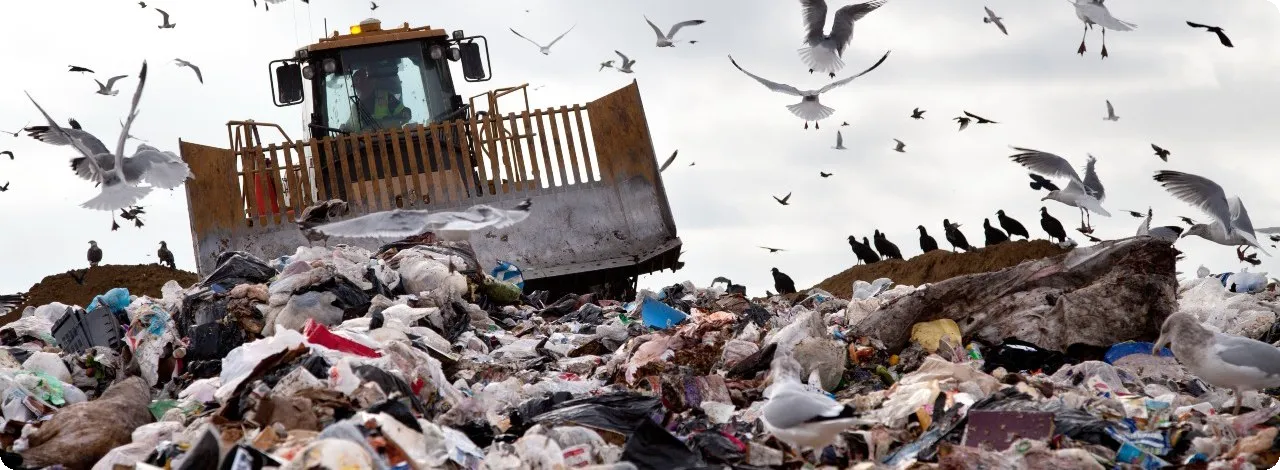
A city of one million people generates about 1.22 million tons of municipal solid waste each year, and pays to bury it. Landfills are one of the largest anthropogenic methane sources.
At the same time, demand for industrial carbon and fuel keeps climbing. The same waste a city pays to dispose of is a dense carbon carrier.
TiPs turns that liability into product. Tipping fees a city already pays become an input-side revenue line that neither tires nor coal can offer.
A city pays to bury this waste. TiPs turns that liability into carbon, fuel, and water.
The Thermal-static internal Pyrophinic system (TiPs) is a sealed, low-temperature, vacuum-driven thermal mechanical depolymerization process. After sorting and drying, it converts municipal waste into carbon, fuel oil, and potable water.
A city of one million people generates about 1.22 million tons of municipal solid waste each year. Fed to a single six-unit TiPs facility, after sorting and drying, 880,000 tons of dry feedstock becomes carbon, fuel oil, and potable water. Nothing is landfilled.
Landfills are one of the largest anthropogenic methane sources. TiPs takes that material out of the ground entirely, with syngas running the dryer and the unit in a closed loop.
Outputs: industrial carbon, 61M gallons of fuel oil, 337M litres of potable water, and mineral residue to cement. Modular and distributed, deployable at one landfill site or several, sized to the city.
The TiPs system behind this project is the same one validated independently on tire feedstock (Tokai Carbon / Sid Richardson analysis, see the End-of-Life Tires page). Feedstock-specific validation is completed as part of each project business case, built on the assay of the actual feedstock.
Select a product stream to see its uses and the market it sells into.
Robust industrial-grade carbon recovered from the dry feedstock, sold into bulk materials markets.
Industrial oil recovered from the hydrocarbon fraction, sold as a robust industrial grade.
The mineral fraction of the waste, recovered as a feed for cement and construction materials.
Syngas captured during processing. It runs the dryer and the unit in a closed loop, with recovered moisture returned as potable water.
Modeled output for sorted, dried municipal waste, before recovered moisture. Composition varies widely by city and sorting; each project is built on the actual waste characterization.
TiPs recovers commercial-grade products from a mixed feedstock. Because municipal waste carries contamination, the carbon and oil are sold as robust industrial grades rather than tire or coal grades. The model is built on product value.
Industrial carbon from the dry feedstock, sold into bulk materials markets.
Industrial oil from the hydrocarbon fraction, with established offtake markets.
Potable water captured from the feedstock moisture, plus mineral residue.
Where the feedstock carries moisture, TiPs captures it and returns it as potable water rather than venting it.
Municipal waste has two incumbent routes: burn it or bury it. TiPs replaces both with material recovery and recovered water.
| Dimension | TiPs | Pyrolysis | Mass-burn incineration | Landfill |
|---|---|---|---|---|
| Process | Sealed, low-temperature depolymerization of sorted, dried waste. | High-temperature thermochemical cracking, 400 to 800C. | High-temperature combustion, 850C and above. | No processing. Waste buried in the ground. |
| Products | Carbon, fuel oil, potable water, mineral residue. | Fuel oil, low-grade char, syngas. | Heat and power, with fly ash and bottom ash. | None. The material value is lost. |
| Material value | Preserved and sold into industrial markets. | Partially destroyed, lower-value byproducts. | Destroyed in combustion. | Stranded and lost. |
| Environmental | Zero waste to landfill, water recovered, no combustion. | Energy-intensive, char disposal issues. | Dioxin and NOx emissions, hazardous fly ash. | Methane, leachate, and permanent land use. |
| Deployment | Modular, distributed, at one landfill or several. | Large centralized plants. | Large centralized plants. | Permanent land use and long-term liability. |
SENS delivers waste-to-value solutions at scale. Whether you represent a municipality, a government, a waste operator, or an investment fund, we invite you to explore what TiPs can do with municipal solid waste in your region.
SENS · Municipal Solid Waste Full project brochure, including the project economics (PDF)End-of-life tires become tread-grade N330 carbon black, high-aromatic oil, and closed-loop process gas.
Run-of-mine coal becomes solid industrial carbon, fuel oil, and process gas, before any combustion.
TiPs runs in front of the boiler: 400 MW of cleaner baseload power plus exportable fuel oil from one line.