Carbon
Tread-grade N330 carbon black that goes back into tires, plus bulk industrial carbon for other markets.
- Tires, belts, and rubber goods
- Advanced concrete
- Metallurgical carbon for steel
- Soil and agriculture

Waste to Value · End-of-Life Tires
One proprietary low-temperature process converts end-of-life tires into tread-grade carbon black, high-aromatic oil, and self-generated process gas, with zero waste streams.
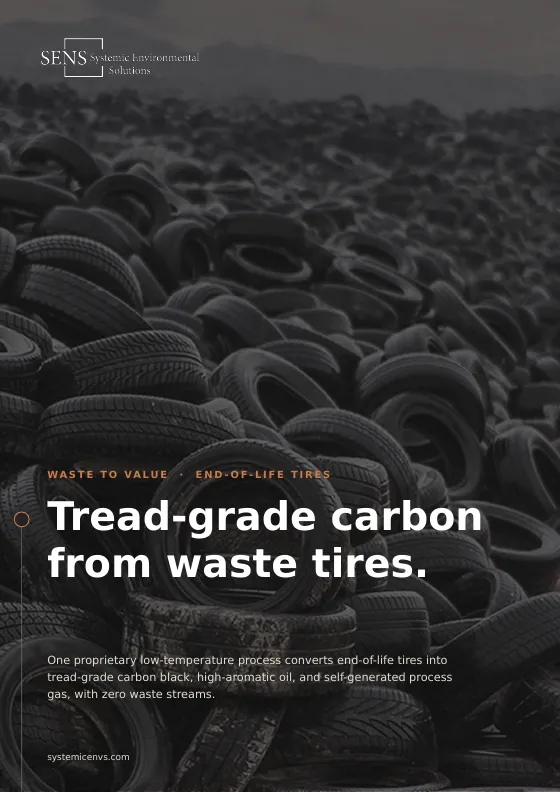
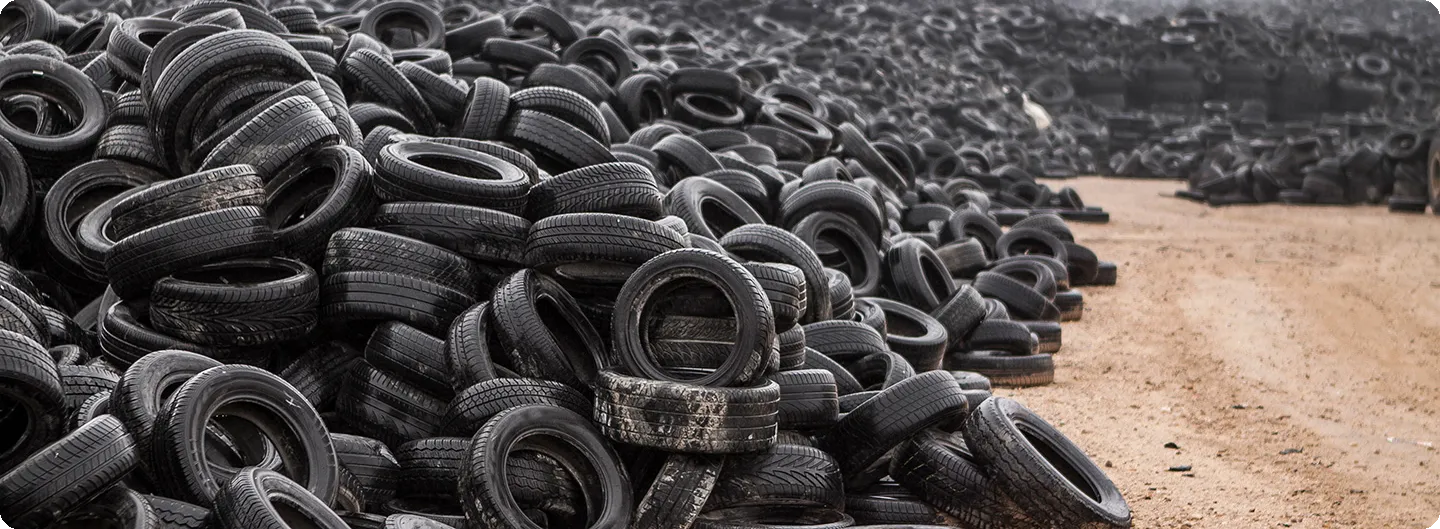
The world cannot absorb the tires it discards. More than 4 billion end-of-life tires sit in stockpiles, with roughly 1.5 billion more added every year. Most are landfilled, stockpiled, or burned as low-grade fuel.
At the same time, demand for industrial carbon keeps climbing. The carbon black bound up in a tire is the same material new tires are built from, and conventional recovery rarely returns it at usable grade.
TiPs treats a scrap tire as what it is: a carbon carrier. It recovers the materials the tire already contains and returns them as saleable product.
The gap between what a scrap tire contains and what the market pays for carbon is the opportunity.
The Thermal-static internal Pyrophinic system (TiPs) is a sealed, low-temperature, vacuum-driven thermal mechanical depolymerization process. Instead of burning the tire, it recovers the carbon, oil, and gas, and returns each as a saleable product.
TiPs converts tire crumb into materials validated against virgin equivalents. The carbon black is a direct N330 tread-grade replacement. Most recovered carbon black never reaches that grade; TiPs carbon does, and goes back into new tires in a closed tire-to-tire loop.
The diluent is a 200+ constituent aromatic solvent with naturally occurring d-limonene. At Noble, Oklahoma, 88,000 tons of annual crumb rubber supply is secured under a long-term agreement.
Outputs: N330-grade carbon black (Tokai Carbon validated), high-aromatic diluent and solvent (Herty / CRC validated), and fuel oil and gas that powers the unit.
“Rubber testing confirmed comparable cure behavior, strong tensile and elongation values, and equal or better abrasion resistance than the N330 control.”
Independent analysis, Sid Richardson Carbon Co, a division of TOKAI CARBON (Japan)
Select a product stream to see its uses and the market it sells into.
Tread-grade N330 carbon black, validated against virgin material and sold back into tire manufacturing in a closed tire-to-tire loop.
High-aromatic oil, 85 to 95% aromatic content, plus a 200+ constituent solvent with naturally occurring d-limonene.
Non-condensable gas captured during processing. It powers the TiPs unit and crumb drying in a closed loop.
Typical recovered output per ton of crumb rubber. Fractions vary with feedstock; each project is built on the assay of the actual feedstock.
Every TiPs output is a commercial-grade product, not a downgraded byproduct. On the tire side, the carbon black returns to tire manufacturing and the diluent reaches high-value solvent markets. The model is built on product value.
Tread-grade N330 carbon black that goes back into tires, plus bulk industrial carbon for other markets.
High-aromatic oil, 85 to 95% aromatic content. A 200+ constituent solvent with d-limonene.
Non-condensable gas captured during processing. It powers the TiPs unit and crumb drying.
Every fraction leaves as a product. Nothing is downgraded to a byproduct.
End-of-life tires have an incumbent disposal route. TiPs replaces all of them with material recovery instead of destruction.
| Dimension | TiPs | Pyrolysis | TDF (tire-derived fuel) | Landfill / stockpile |
|---|---|---|---|---|
| Process | Sealed, low-temperature thermal mechanical depolymerization under vacuum. | High-temperature thermochemical cracking, 400 to 800C. | Whole or shredded tires burned as fuel in cement kilns and boilers. | No processing. Whole or shredded tires buried or stockpiled. |
| Products | Carbon, fuel oil, process gas, recovered solvent. | Fuel oil, low-grade char, syngas. | Heat only. The carbon and oil are lost to combustion. | None. The material value is lost. |
| Material value | Preserved and sold into product markets, including N330. | Partially destroyed, lower-value byproducts. | Destroyed in combustion. | Stranded and lost. |
| Environmental | Zero waste streams, no combustion in the process. | Energy-intensive, char disposal issues. | Stack emissions and ash. Displaces coal, but burns the material. | Fire risk, leaching, and vector breeding. |
| Deployment | Modular, distributed, on-site at the supply. | Large centralized plants. | Burned in existing kilns and power boilers. | Permanent land use and long-term liability. |
SENS delivers waste-to-value solutions at scale. Whether you represent an investor, a manufacturer, a municipality, or a fund, we invite you to explore what TiPs can do with end-of-life tires in your region.
SENS · End-of-Life Tires Full project brochure, including the project economics (PDF)A city's sorted waste becomes industrial carbon, fuel oil, and potable water, with nothing sent to landfill.
Run-of-mine coal becomes solid industrial carbon, fuel oil, and process gas, before any combustion.
TiPs runs in front of the boiler: 400 MW of cleaner baseload power plus exportable fuel oil from one line.